

These D.C. Youth Are Committed to Keeping Go-Go Alive in the Nation’s Capital
 Veracity SavantDecember 14, 20254 Mins read356
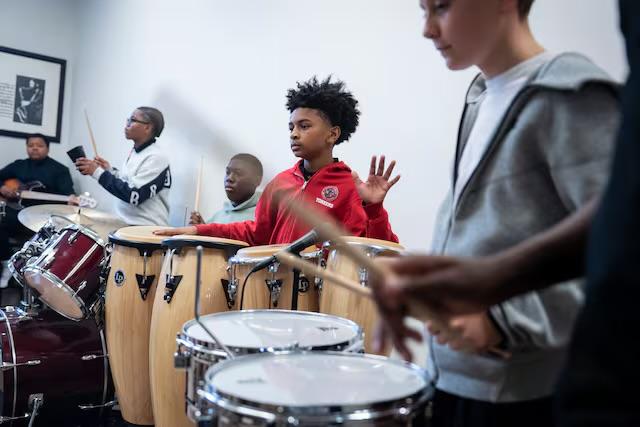
Go-go may be the official music of the nation’s capital, but for years it has lived mainly in the memories of older generations. Its legends are aging, its golden era long past, and many D.C. teens have leaned more toward rap, trap, and hip-hop. Still, inside classrooms, recreation centers, and community spaces across the city, young people are bringing the sound back in a powerful way, The Washington Post reports.
Kids as young as 11 are forming bands, often with guidance from the very musicians who helped shape go-go’s legacy. Teens who were not even born when Chuck Brown died in 2012 are finding their own entry point into the genre, remixing its traditions and inviting their peers to see it differently.
“The only way you can preserve something is if the young people take it over,” said Ron Moten, a longtime activist, go-go historian, and one of the founders of the Go-Go Museum in Anacostia. “We didn’t have a pipeline for that with go-go until some adults stepped up and said let me help these young people get into this music, get into this history; that’s something they’re missing.”
In a small music room inside the SEED School of Washington, the walls struggle to contain the energy pouring out. Drums snap, bass lines fill the room, and a pocket locks in so tight you can feel it in your chest before you even step inside. For a few minutes, nothing else matters.
17-year-old SEED senior Kevin Ivy leads the class in playing Junkyard under the direction of Jennifer Kennedy, a music teacher at the school.
Just like that, the unmistakable groove of go-go fills the hallway, blending percussive funk, Latin rhythms, gospel, blues, and soul into something that feels alive. Students, teachers, and staff bob their heads in unison. The music pulls everyone in.
That pipeline from music classes to go-go stages matters now more than ever. As D.C. teens face increased policing, curfews, and restrictions on gathering, educators and musicians say go-go offers a release and a sense of belonging. It gives young people somewhere to be, something to build, and a reason to stay focused.
Go-go’s relationship with youth has not always been celebrated. In the late 1980s and 1990s, as the genre gained national attention, D.C. lawmakers cracked down on shows, blaming young people for crime and disorder. Police raids became common, and teens were often treated as the problem rather than the promise.
“Back then, when you would have problems at the shows, it was never the bands, never the music,” said Janice Carroll, who managed the go-go band Jigga in the 1990s and now serves as a student coordinator at SEED. “It was always the outside stuff that seeped in.”
Those echoes feel familiar today, according to Moten.
“There are parallels from then to now, which is that you have some children who are doing the wrong thing and the whole city is going to get slammed for it,” Moten said. “The rest of us, meanwhile, are being indoctrinated with this narrative that young people are bad, young people are dangerous. How many news stories have you seen about the good things these young people are doing?”
That narrative is precisely what today’s go-go mentors are trying to change.
At 46, Kenny “Kwick” Gross is a certified go-go legend, known for his work with Rare Essence and the Chuck Brown Band. He was only 19 when he first joined a band, and even then, the road was not easy. Now, he spends his time pouring into the next generation at SEED, coaching students as they sharpen their musical instincts.
“I feel like I got to do my best to keep it going,” Gross said. “I mean, the name of the music is go-go — it can’t just stop. And we getting old. So somebody’s got to know how to do this, how to keep it going when we’re finished. And they can’t do that without us helping show them the way.”
The students in the Sounds of SEED program are already stepping up. Some bounce effortlessly between drums, bass, keyboard, and vocals, while others are just beginning their musical journey. Recently, they competed in a youth battle of the bands at the Go-Go Museum, with opportunities to perform at holiday shows, a Washington Wizards Go-Go basketball game, and the upcoming Go-Go Awards in January.
For the students, this is bigger than music.
“Being young and playing music that’s come down from generations to generations, it’s actually heartwarming to me because I can still learn where the roots were, how the music was created, and what made D.C. D.C.,” Ivy said.
“It feels like a gift, almost,” said London Dailey, 17. “It’s like, from the people who played it before, it’s like: Here you go now, you get to experience it and show everybody else how to play it and, you know, spread it throughout your community.”
They are not afraid to experiment, either. During one practice, the band transformed Ludwig van Beethoven’s Fifth Symphony into a funky go-go groove after hearing it trend online.
“We heard it going around on TikTok,” Dailey said. “And I thought, we could do something different with that.”
Across the city at Stuart-Hobson Middle School, music director BJ Simmons is leading a student go-go band called Panther Funk, blending brass, strings, percussion, and vocals. For eighth grader Caleb Johnson, the experience changed how he thinks about music altogether.
“I like listening to old music — like Alicia Keys, Anthony Hamilton, Erykah Badu — so it’s cool that we can take something that we already love and combine it with something new to bring it back in a different way,” Johnson said.
For him, and many others, go-go hits on a deeper level.
“Go-go is good for the heart,” Johnson said. “It’s heart music.”
That heart shows up in the smallest moments, like when a student wandering between classes can’t resist the rhythm, steps inside, and joins in with a cowbell. The band plays on, smiling, fully locked in.
That is the magic of go-go. It invites you in. It keeps you moving. And thanks to a new generation of D.C. kids, it is not just surviving. It is growing, evolving, and doing exactly what it has always done best.
Cover photo: These D.C. Youth Are Committed to Keeping Go-Go Alive in the Nation’s Capital/Aiden Yonkers, 13, plays bongos during a rehearsal, Nov. 2025/Photo credit: Jabin Botsford/The Washington Post






Black Female DJs in the DMV Are Elevating the Game
At MVEMNT, inclusion is not something we talk about. It is something...
 MVEMNT Staff2 Mins read

Celebrating Women’s History: Sommer Hill’s DMV Podcast Bootcamp Lifts New Voices
In the ever growing podcast industry, Sommer Hill is proving that success...
 Leah Henry4 Mins read

Live Nation’s Settlement With the DOJ Could Change the Concert Ticket Experience
A high stakes legal fight that could have reshaped the live entertainment...
Leah Henry4 Mins read

Buckle Up: Airline Ticket Prices May Soon Take Off Amid Rising Fuel Costs
Travelers hoping to score cheap flights this year may soon face higher...
Leah Henry3 Mins read





Leave a comment